How to Choose the Right Touch-Sensitive Spring?
Choosing the right Touch-Sensitive Spring is a small engineering decision with significant practical consequences. Its response can affect user comfort, switching accuracy, product life, and assembly reliability. A spring that feels responsive on a test bench may feel stiff inside a finished enclosure. That difference matters.
The selection process should begin with the application, not the catalog. Consider the required force, travel distance, working height, coil diameter, material, and expected cycle life. Electrical contact conditions may also influence the design, especially in compact control panels, wearable devices, and precision interfaces. Engineers should compare force-deflection data with real operating conditions. Temperature, vibration, moisture, and manufacturing tolerances can change performance over time.
Feel the difference.
Practical testing remains essential. Measure the spring with calibrated equipment, then install samples in the actual housing. Check whether the button returns smoothly, whether contact bounce appears, and whether repeated compression causes permanent deformation. Supplier documentation provides valuable guidance, but it should not replace independent verification. A reputable manufacturer should explain material grades, testing methods, dimensional tolerances, and traceability.
There is no universal best spring. A low-force model may improve comfort but create accidental activation. A stronger design may prevent false inputs while tiring users during repeated operation. This trade-off is easy to underestimate. Even experienced teams can overlook friction from nearby parts or slight misalignment during assembly. Reviewing these weaknesses early helps create a more reliable choice. The right Touch-Sensitive Spring balances tactile feedback, mechanical stability, manufacturing practicality, and long-term consistency.
Define the Application and Touch-Sensing Requirements
Choosing the right touch-sensitive spring begins with the application, not the catalog.
Describe what the spring must detect: a finger press, panel flex, vibration, or repeated mechanical contact. A spring beneath a glass panel may need a softer response than one beneath a rigid control surface. Record the available space, compression distance, target force, and expected operating cycles. Small details matter.
Define the sensing requirement before selecting dimensions.
Decide whether the system needs a clear on/off event, graded pressure response, or stable electrical continuity. For capacitive sensing, nearby metal, panel thickness, and grounding can change sensitivity. For mechanical detection, specify actuation force, travel, rebound, and acceptable hysteresis. Set measurable limits for contact resistance, signal noise, and false triggers. Do not copy a force value from another assembly.
An experienced development process tests the spring inside the finished enclosure.
Measure its response with gloves, dry fingers, dusty surfaces, and temperature changes when relevant. Check alignment after thousands of cycles, not only during the first fitting. Use technical drawings, tolerance data, and sample testing, while treating early results as provisional. I once focused on nominal force and missed side loading from a slightly tilted panel. That mistake changed the contact feel and caused inconsistent readings. The spring also needs enough retention to stay centered without restricting its movement.
Identify the Spring’s Key Mechanical and Electrical Specifications
How to Choose the Right Touch-Sensitive Spring?
Identify the Spring’s Key Mechanical and Electrical Specifications
Touch-sensitive springs must satisfy mechanical and electrical requirements at the same time. Start with contact force, working travel, spring rate, free length, and solid height. The basic relationship is F = kx + preload. A 0.20 N preload can prevent false touches, but excessive force may reduce user comfort. Measure force at the actual operating position, not only at free length.
Electrical data deserves equal attention. Record contact resistance, rated current, operating voltage, insulation needs, and acceptable signal bounce. A spring carrying current can heat during repeated operation. Check resistance after cycling, not just during initial inspection. Grand View Research valued the global touch sensor market at about USD 6.99 billion in 2023, with projected double-digit growth through 2030. That growth increases pressure for repeatable, compact contact designs.
Material choice changes performance. Stainless steel supports corrosion resistance, while copper alloys often provide better conductivity. Plating can improve contact stability, but wear may expose the base metal. MarketsandMarkets estimates the force sensor market could grow from roughly USD 2.5 billion in 2024 to USD 4.4 billion by 2029. This reflects rising demand for controlled force measurement. In bench testing, a spring that feels perfect by hand may fail after thousands of cycles. That is an easy mistake. Test compression, fatigue, temperature, humidity, and contamination together. ASTM A228 or equivalent material data can help, but real assembly testing remains essential.
How to Choose the Right Touch-Sensitive Spring?
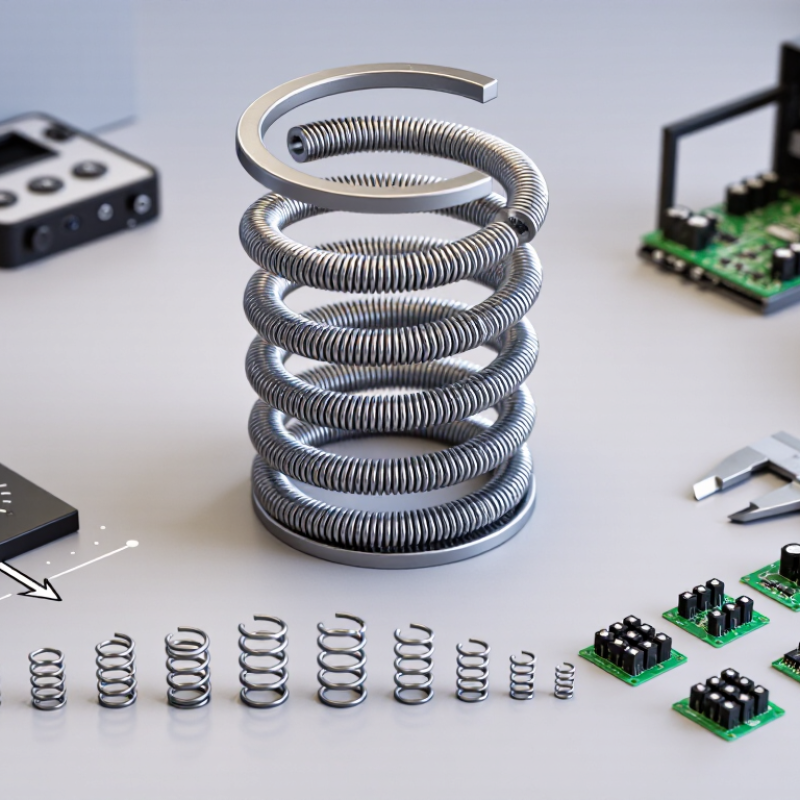
Compare the spring’s mechanical response with its electrical performance. Higher contact force can improve stability and reduce intermittent contact, while lower resistance and adequate current capacity support reliable signal or power transmission. The values shown are representative engineering ranges for compact touch-sensitive spring contacts; final selection should be verified through testing under the intended stroke, temperature, and environmental conditions.
Match the Spring to Environmental and Durability Conditions
Choosing the right touch-sensitive spring begins with its environment, not its shape. Humidity, salt, dust, vibration, and temperature can change contact force and signal stability. The NACE IMPACT study estimates that corrosion costs about 3.4% of global GDP, or nearly US$2.5 trillion annually. That figure makes material selection more than a design preference.
For damp or coastal equipment, consider corrosion-resistant alloys and suitable surface finishes. However, a salt-spray result does not predict real service life. ASTM B117 itself warns against treating exposure hours as a direct field warranty. Test the complete spring assembly under realistic humidity, contamination, and electrical loads. For moving equipment, follow IEC 60068-2-6 for vibration and IEC 60068-2-27 for shock. Check contact force after cycling, not only before installation. A spring can still look bright while its electrical performance quietly declines. That is an easy mistake.
Tips: Define the temperature range first. Then specify expected touch cycles, vibration levels, and allowable contact resistance. Leave safety margin for manufacturing variation. If the device operates near salt, condensation, or cleaning chemicals, use accelerated testing with periodic resistance checks. Avoid choosing the hardest spring automatically; excessive force may damage a thin sensing surface. In practice, a slightly lower-force design may feel better and last longer, but this should be verified with measured cycle data.
Test and Confirm the Final Spring Selection
How to Choose the Right Touch-Sensitive Spring?
Test and Confirm the Final Spring Selection
A touch-sensitive spring can feel correct on a workbench yet fail inside a finished product. I have seen small changes in spring height alter the touch response noticeably. Begin by testing the spring in its actual housing, not only in isolation. Record free height, compressed height, contact force, and electrical resistance. Use a calibrated force gauge when possible. A simple hand test is useful, but it is not enough for a dependable decision.
Test several samples from different production batches. Apply the same touch force at the same travel distance. Then repeat the test after 1,000, 5,000, and 10,000 compression cycles. Check for unstable signals, delayed response, permanent deformation, and surface wear. Temperature can also change spring behavior. Test at low, normal, and elevated operating temperatures. Do not accept one successful sample as proof. That assumption is easy to make, and often wrong. Define practical limits before testing, such as response time, force range, and resistance variation.
Tips: Keep a test record with photographs, measurements, and operator notes. Inspect the spring under magnification after cycling. Compare results against the product’s real touch panel and assembly pressure. If results conflict, repeat the test with a fresh fixture. Small fixture errors can imitate spring failure. Leave room for manufacturing tolerance, because a perfect prototype may not represent production performance.