For global electronics buyers, choosing the right Plastic Carrier Tape in 2026 involves more than comparing prices. The tape must protect components, support stable feeding, and match automated assembly equipment. A small dimensional error can cause pocket misalignment, component rotation, or repeated line stoppages.
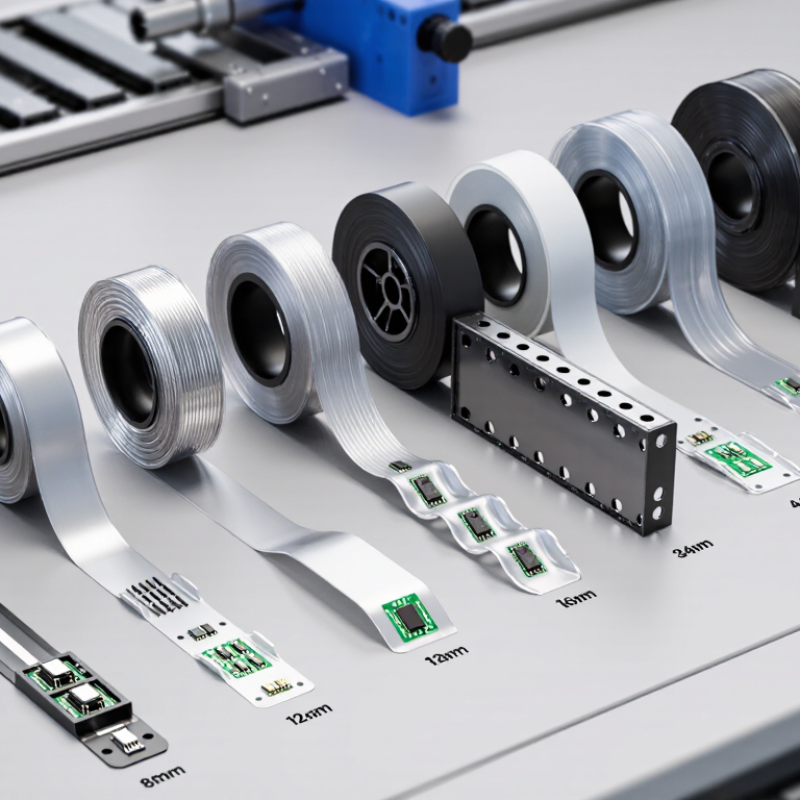
Common options include embossed polystyrene, polyester, polycarbonate, and conductive or antistatic structures. Each material serves different packaging needs. Embossed tape remains widely used for semiconductors, LEDs, connectors, and precision passive components. Buyers should examine pocket dimensions, tape width, pitch, sprocket-hole accuracy, cover-tape compatibility, and sealing performance. Typical widths include 8, 12, 16, 24, 32, 44, and 56 millimeters.
Details matter.
A reliable supplier should provide technical drawings, material data, inspection records, and traceable production information. Experience with high-speed pick-and-place lines can reveal problems that a simple sample review misses. ESD control, dimensional consistency, clean manufacturing, and suitable storage conditions also deserve careful attention. Documentation should support applicable environmental and chemical requirements, including RoHS and REACH considerations where relevant.
However, no single tape type suits every global application. A visually perfect sample may still perform poorly after transportation, humidity exposure, or extended storage. Some buyers focus too heavily on unit price and overlook tooling costs, scrap rates, and line efficiency. This guide compares the leading Plastic Carrier Tape types for 2026, while recognizing that supplier validation remains essential. Practical testing is still the safest decision.
What Is Plastic Carrier Tape and How Is It Used?
Plastic carrier tape is a precision packaging strip for small electronic components. It uses formed pockets to hold resistors, capacitors, sensors, and integrated circuits. A cover tape seals each pocket. The complete reel then feeds components into automated surface-mount assembly equipment.
Common materials include polystyrene, PET, polycarbonate, and antistatic blends. Embossed tape suits many standard components, while punched tape supports selected packages and higher dimensional control. Material choice affects pocket strength, static protection, transparency, and heat performance. WSTS forecast global semiconductor sales at 611 billion dollars in 2024 and 687 billion dollars in 2025. That growth increases demand for stable, machine-ready packaging. Yet tape selection is often treated as a minor purchasing detail. It is not. A slightly loose pocket can tilt a tiny chip, causing pick-and-place errors.
Tips: Check pocket dimensions against the component drawing, not only the supplier’s product name. Confirm reel width, pitch, cover-tape peel force, and antistatic performance. IPC/JEDEC J-STD-033 provides handling guidance for moisture-sensitive devices, while EIA-481 defines important carrier-tape and reel practices. Ask for dimensional inspection records and sample reels before mass production. A practical test should include transport vibration, machine feeding, and visual inspection under real factory conditions. Small gaps in verification remain a common weakness, even among experienced buyers.
Plastic carrier tape is classified by more than its width. Buyers should examine forming method, material, pocket design, and electrical performance. The main forming categories are embossed tape and punched tape. Embossed tape creates pockets by heating and shaping a polymer sheet. Punched tape cuts pockets into a thicker base material. Embossed tape usually suits small and lightweight components. Punched tape can provide deeper pockets for larger parts. Fit matters.
Material creates another classification layer. Common options include polystyrene, polycarbonate, polyester, and ABS-based compounds. Selection depends on pocket rigidity, heat resistance, transparency, and static-control requirements. IEC 60286-3 defines key dimensions for component packaging, including pocket pitch, sprocket-hole geometry, and tape width. These details affect feeder stability on high-speed assembly lines. A 4 mm pitch error can cause visible indexing problems. That is risky.
Electrical behavior also separates tape types. Standard tape may be enough for non-sensitive components, while dissipative or conductive grades support electrostatic-control programs. Buyers should request surface-resistance data, not vague “ESD safe” claims. The WSTS Spring 2024 Market Forecast projected global semiconductor sales of 611 billion dollars in 2024, rising 16.0%, with further growth expected in 2025. SEMI’s 2024 manufacturing outlook also indicated continued capacity expansion. These figures suggest stronger packaging demand, but they do not prove every tape category will grow equally. Classification remains application-specific. In practice, suppliers sometimes confuse material grade with performance grade. I have seen that mistake delay qualification. A better review checks dimensions, resin behavior, pocket strength, cover-tape compatibility, and recycling conditions together.
Plastic carrier tape is commonly classified by material, pocket design, component size, tape width, and cover-tape compatibility. The chart shows widely used nominal carrier-tape widths in millimeters. Narrow formats are generally used for small electronic components, while wider formats accommodate larger or heavier components.
Top Plastic Carrier Tape Types for Global Buyers in 2026
Plastic carrier tape selection is becoming more technical as semiconductor packages grow smaller. WSTS forecast global semiconductor sales at about US$697 billion in 2025, an 11.2% annual increase. This growth supports demand for reliable tape-and-reel packaging. Embossed polystyrene tape remains practical for standard passive components and small integrated circuits. It offers stable forming, clear pocket definition, and competitive pricing.
Polycarbonate tape suits buyers needing stronger dimensional stability and deeper pockets. It performs well during automated high-speed feeding. Conductive or dissipative grades help control electrostatic discharge around sensitive components. Polyester tape can support cleaner surfaces and better stiffness, although its cost may be higher. Materials must match the component body, pocket depth, cover tape, and sealing temperature.
Standard compliance matters. EIA-481 remains a key reference for pocket dimensions, sprocket holes, and tape alignment. IPC packaging guidance also stresses protection against moisture, dust, and electrostatic damage. Buyers should request tensile strength, surface resistance, pocket tolerance, and sealing test data. A low-cost tape can still create costly feeder jams. That part is often underestimated.
In 2026, recyclable content and material traceability may influence purchasing decisions. However, recycled resin is not automatically suitable for precision pockets. Quality can vary between production batches. Trial runs remain essential, especially for narrow tapes, deep pockets, and fragile packages. Report sources: WSTS Semiconductor Market Forecast, 2025; EIA-481 packaging standard; IPC component packaging guidance.
Top Plastic Carrier Tape Types for Global Buyers in 2026
| Plastic Carrier Tape Type | Primary Resin | Typical ESD Performance | Common Carrier-Tape Widths | Typical Component Applications | Key Technical Advantages | Limitations and Buyer Considerations | Recycling and Compliance Considerations | Best Fit for Global Buyers in 2026 |
|---|---|---|---|---|---|---|---|---|
| Antistatic Polystyrene (PS) Embossed Tape | Polystyrene with an antistatic additive or surface treatment | Usually designed to reduce charge accumulation; the exact surface-resistance range is specification-dependent and should be verified against the required ESD standard. | 8 mm 12 mm 16 mm 24 mm 32 mm 44 mm+ | Resistors, capacitors, diodes, small connectors, sensors and other low-to-medium profile components | Cost-effective, lightweight, easy to thermoform and widely available in standard tape formats | Limited temperature resistance compared with polycarbonate; additive performance can vary with humidity, storage time and handling conditions. | Confirm local recycling rules for polystyrene and verify that additives do not conflict with the customer’s restricted-substance requirements. | High-volume standard components where cost, availability and normal assembly conditions are the main priorities |
| Conductive Polystyrene (PS) Embossed Tape | Polystyrene formulated with conductive carbon-based or other conductive additives | Low electrical resistance compared with antistatic PS; the supplier should provide measured resistance values and test conditions. | 8 mm 12 mm 16 mm 24 mm 32 mm+ | ESD-sensitive integrated circuits, semiconductor packages, sensors and precision electronic parts | Provides a more controlled path for charge dissipation and can support protected handling in automated pick-and-place lines | Carbon additives normally make the tape opaque or dark, which can limit visual inspection; mechanical and thermal performance remains below many engineering plastics. | Conductive additives may affect recycling streams. Request material declarations and ESD test reports for international shipments. | ESD-sensitive components that do not require high-temperature processing or transparent pocket inspection |
| Clear PET Embossed Tape | Polyethylene terephthalate, normally transparent and thermoformable | Base PET is not automatically ESD-safe; antistatic or dissipative treatment is required when ESD control is specified. | 8 mm 12 mm 16 mm 24 mm 32 mm 44 mm+ | Optical sensors, small connectors, LEDs, miniature modules and components requiring visual pocket inspection | Good transparency, dimensional stability and useful resistance to many common handling and packaging conditions | Plain PET may accumulate static charge; deep or complex pockets may require careful forming and cover-tape matching. | PET has established recycling identification in many markets, but coatings, adhesives and mixed-material laminates can affect recyclability. | Applications prioritizing transparency, dimensional consistency and visual quality control |
| Antistatic PET Embossed Tape | PET with antistatic coating or internal antistatic formulation | Controlled charge generation is possible, but resistance and decay performance depend on the treatment, humidity and test method. | 8 mm 12 mm 16 mm 24 mm 32 mm+ | ESD-sensitive sensors, optical parts, connectors and components requiring transparent or semi-transparent pockets | Combines PET dimensional stability with improved electrostatic control and generally good pocket visibility | Surface treatments can lose effectiveness through abrasion, contamination or prolonged storage; qualification under the buyer’s environmental conditions is important. | Ask for coating composition, surface-resistance data, humidity conditions and declarations required by the destination market. | Global supply chains needing a transparent ESD-control option with stable forming performance |
| Conductive PET Embossed Tape | PET with conductive fillers or a conductive coating | Designed for stronger charge dissipation than standard antistatic PET; actual resistance must be specified by product design and test method. | 8 mm 12 mm 16 mm 24 mm 32 mm+ | High-value electronic devices, precision sensors, semiconductor-related parts and ESD-critical assemblies | Can provide a balance between PET’s dimensional stability and improved electrical discharge control | Conductive coatings or fillers may reduce clarity, increase material cost and require compatibility checks with cover tape and sealing equipment. | Review conductive additive content, coating chemistry and end-of-life requirements before selecting it for large international programs. | ESD-critical parts where dimensional stability is important and moderate visibility is acceptable |
| Polycarbonate (PC) High-Temperature Carrier Tape | Polycarbonate, often supplied in antistatic or conductive grades | ESD performance is grade-specific; PC carrier tape can be formulated for antistatic or conductive handling. | 8 mm 12 mm 16 mm 24 mm 32 mm+ | Automotive electronics, power components, sensors, connectors and parts exposed to elevated assembly or storage temperatures | Higher heat resistance, toughness and dimensional stability than many general-purpose PS tapes | Higher material and tooling cost; forming conditions and sealing parameters must be carefully matched to avoid pocket distortion. | PC recycling availability differs by region. Request resin identification, additives information and compliance documentation for the target market. | High-reliability or higher-temperature applications where dimensional retention is more important than minimum packaging cost |
| Conductive PC Carrier Tape for Deep or Heavy Pockets | Conductive or dissipative polycarbonate with reinforced embossed geometry | Specified for controlled electrical dissipation; the required resistance range should be agreed with the component owner and assembly site. | 16 mm 24 mm 32 mm 44 mm 56 mm+ | Large connectors, power semiconductors, modules, electromechanical parts and components with high mass or tall profiles | Improved rigidity, impact resistance and pocket stability for heavier or deeper components | Requires accurate pocket design, stronger web support and compatible cover-tape peel performance; cost is normally higher than standard PS. | Conductive additives and multi-material cover systems should be reviewed for recycling and restricted-substance requirements. | Heavy, deep or high-value ESD-sensitive components that need stronger mechanical protection during global logistics |
| Custom Multi-Layer or Coated Plastic Carrier Tape | Plastic base layer such as PS, PET or PC combined with a functional coating or laminated layer | Can be engineered for antistatic, dissipative or conductive performance; electrical results are dependent on layer structure and environmental conditions. | 8 mm–120 mm Custom widths | Irregular components, fragile parts, high-cavity pockets, precision optical parts and specialized automotive or industrial electronics | Allows customization of stiffness, transparency, ESD behavior, pocket geometry and sealing characteristics | Longer qualification time, higher tooling cost and more complex recycling compared with single-resin tape | Obtain a full material composition, coating declaration, recyclability statement and destination-market compliance documents. | Specialized parts where standard single-material carrier tapes cannot meet protection, inspection or automation requirements |

| Buyer note: Carrier-tape dimensions, pocket geometry, resistance values, temperature limits and cover-tape compatibility are specification-dependent. Common widths follow industry packaging conventions, while the correct tape should be validated against the component outline, pocket pitch, feeder system, sealing process, ESD program and destination-market requirements. | ||||||||
2026 Top Types of Plastic Carrier Tape for Global Buyers
How to Match Carrier Tape Types with Component Requirements
Carrier tape selection starts with the component, not the packing machine. Small passive parts usually suit shallow pockets and narrow tape widths. Larger connectors need deeper cavities, stronger walls, and better cover-tape support. Fit comes first. A pocket that is too loose can allow rotation, while a tight pocket may damage leads during loading.
For moisture-sensitive or static-sensitive devices, use plastic tape with controlled electrostatic properties and suitable moisture-barrier packaging. Conductive or dissipative grades can reduce electrostatic risk when validated under IEC 61340-5-1 practices. Transparent tape helps vision inspection, but it may not provide enough stiffness for heavy components. Polycarbonate, polystyrene, and polyester constructions each balance rigidity, clarity, and cost differently. The choice needs testing.
SEMI’s World Fab Forecast database tracks more than 1,400 fabs and production lines worldwide, showing why one tape specification cannot serve every supply chain. WSTS forecast global semiconductor sales at about 687 billion dollars for 2025, increasing pressure on packaging consistency. Buyers should compare pocket pitch, cavity tolerance, tape width, peel force, and reel dimensions against EIA-481 requirements. Then run a short machine trial. I have seen apparently correct samples fail after vibration or temperature changes. That weakness deserves attention. Also review component orientation, terminal height, and pick-up clearance before approving volume production. A lower-cost tape can become expensive when feeding stops, parts tilt, or inspection rejects rise.
2026 Top Types of Plastic Carrier Tape for Global Buyers?
What Global Buyers Should Check Before Purchasing Carrier Tape
Carrier tape selection starts with the component, not the catalog title. Confirm pocket length, width, depth, pitch, and corner geometry against the actual part. A loose pocket can cause movement. A tight pocket may damage leads or exposed surfaces.
Check the base material carefully. Polystyrene suits many general applications, while PET or polycarbonate can offer different stiffness and heat performance. Conductive and dissipative grades need verified surface-resistance data, not vague “ESD safe” claims. Ask for test methods, inspection records, and batch traceability. Numbers without conditions can mislead.
Fit the cover tape to the pocket and sealing process. Review seal temperature, peel strength, sealing width, and compatibility with automated feeders. Inspect sprocket-hole accuracy, tape flatness, winding tension, and visible contamination. Small defects matter. A warped reel can interrupt a high-speed line.
Request samples from the intended production batch when possible. Test them with your feeder, sealing equipment, and storage conditions. Also confirm packaging protection, moisture controls, minimum order quantity, and replacement handling. A supplier may meet the drawing but miss your process reality. I would not approve a large order after checking dimensions alone; that shortcut often needs reconsideration.