Leave Your Message
Choosing among the 10 Best Touch Switches for Global Buyers requires more than comparing prices and glossy product photos. A reliable touch switch should respond consistently, fit the intended panel, and remain stable under repeated daily use. Buyers must inspect sensing distance, operating voltage, installation depth, surface material, and protection ratings. Small details matter. A switch that feels excellent in a showroom may behave differently beside a kitchen sink or inside a humid control cabinet.
Usability expert Steve Krug’s famous advice, “Don’t make me think,” applies strongly to Touch Switch Touch products. Users expect a clear response, whether that means a soft click, an indicator light, or a controlled appliance action. Our evaluation considers touch sensitivity, accidental activation, visual feedback, wiring convenience, and long-term maintenance. It also considers regional realities, including voltage systems, connector standards, supplier documentation, and after-sales support. Experience shows that attractive designs sometimes hide weak instructions. That deserves attention.
No ranking can suit every project. A minimalist glass switch may suit a hotel wall, but not a workshop covered with dust or gloves. Some models respond too easily. Others require an awkwardly firm touch. These imperfections are worth acknowledging, because real installations rarely match laboratory conditions. The following guide compares ten practical options for international buyers, focusing on performance, compatibility, safety information, and purchase confidence. It does not replace professional electrical assessment. Instead, it offers a clearer starting point for careful decisions.
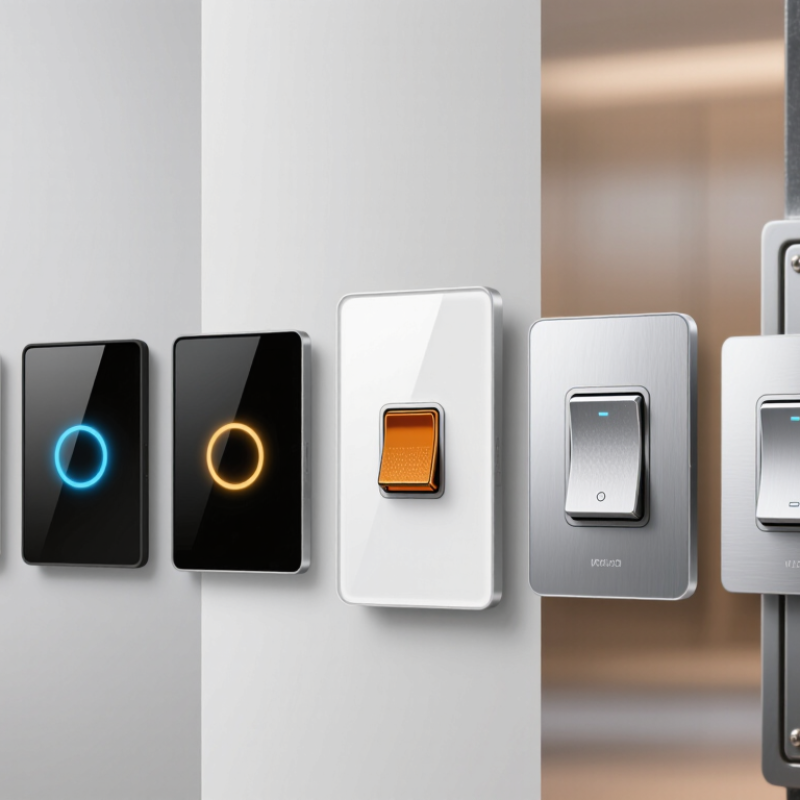
Touch switches respond to a finger instead of a moving lever. Most use capacitive sensing. A thin electrode sits behind glass or plastic. When a finger approaches, it changes the local electrical field. A sensing circuit measures that change and sends a signal to a controller. The controller then activates a relay or solid-state component, turning a light or appliance on and off.
The simple explanation is useful, but incomplete. Touch switches can behave differently in humid rooms, through thick panels, or with insulated gloves. During installation checks, I look for stable sensitivity, clear indicator lighting, and firm terminal connections. A loose connection may cause flickering or delayed response. That detail is easy to miss.
Many models support timer functions, dimming, or remote control. Their operating voltage, load capacity, wiring method, and wall-box size must match the installation. Buyers should also verify regional electrical requirements before purchase. A switch designed for one supply system may not suit another, even when its appearance is identical. Some touch panels feel premium, yet their sensors respond poorly near metal frames. This is where product testing matters more than photographs. A practical test should include dry fingers, damp fingers, repeated touches, and the intended lamp load. No single sensor design performs perfectly in every room.
| Rank | Touch Switch Type | How It Works | Typical Input | Typical Output | Recommended Applications | Main Advantages | Key Limitations | Typical Protection Level | Overall Suitability |
|---|---|---|---|---|---|---|---|---|---|
| 1 | Capacitive Wall Touch Switch | Detects a change in electrical capacitance when a finger approaches or touches the front panel. | 100–240 V AC mains input; some versions use 5–24 V DC | Relay or solid-state switching for lighting and appliances | Residential lighting, offices, hotels and smart-building projects | Clean appearance, silent operation and low mechanical wear | Glass, moisture, grounding and installation conditions can affect sensitivity | Commonly IP20–IP44; higher ratings require sealed construction | ★★★★★ |
| 2 | Projected-Capacitive Touch Panel | Uses a patterned electrode grid to sense the position of a finger through a glass or plastic overlay. | Usually 3.3–5 V DC through a touch controller | USB, I²C, SPI or digital control signal | Control panels, appliances, kiosks, instruments and user interfaces | Supports multi-touch, attractive glass surfaces and fast response | Requires a controller and may need tuning for thick gloves or wet surfaces | Typically IP54–IP65 when optically bonded and sealed | ★★★★★ |
| 3 | Piezoelectric Touch Switch | Converts pressure on a metal surface into an electrical signal through the piezoelectric effect. | Typically 5–24 V DC electronics supply | Momentary pulse, transistor signal or relay output | Public equipment, elevators, industrial controls and outdoor panels | Highly durable, vandal-resistant and suitable for harsh environments | Usually detects a press rather than a light hover; feedback may require a separate indicator | Often IP65–IP69K with a properly sealed metal surface | ★★★★★ |
| 4 | Capacitive Metal Touch Button | Senses capacitance variation through a conductive metal button or bezel without mechanical movement. | Commonly 5–24 V DC | Digital signal, open-collector output or relay output | Industrial machinery, access control, medical equipment and appliances | Long service life, easy cleaning and no mechanical contacts | Metal thickness, nearby wiring and electrical noise can influence detection | Typically IP65–IP67 in industrial sealed designs | ★★★★☆ |
| 5 | Capacitive Membrane Touch Switch | Printed conductive traces detect a change in capacitance beneath a flexible graphic membrane. | Usually 3.3–12 V DC | Digital signal, matrix output or controller input | Consumer electronics, control panels, laboratory equipment and appliances | Thin profile, custom graphics, low cost and easy front-panel integration | Performance may decrease with thick gloves, heavy contamination or moisture | Commonly IP54–IP65 when the membrane edges are sealed | ★★★★☆ |
| 6 | Infrared Touch Switch | Detects interruption or reflection of infrared light caused by a finger near the sensing area. | Typically 5–12 V DC | Digital switching signal, relay output or serial data | Glove-friendly controls, public displays and hygienic interfaces | Can work with gloves and does not require direct electrical contact | Ambient sunlight, dust and reflective objects can cause interference | Typically IP54–IP65 with a sealed optical window | ★★★★☆ |
| 7 | Resistive Touch Switch Panel | Registers pressure when two conductive layers make contact through a flexible spacer. | Usually 3.3–5 V DC through a touch controller | Analog position signal or digital controller output | Industrial terminals, handheld instruments and legacy control equipment | Works with gloves, styluses and almost any pointed object | Requires pressure, has lower optical clarity and may wear over time | Commonly IP54–IP65 when laminated and sealed | ★★★★☆ |
| 8 | Surface Acoustic Wave Touch Panel | Uses ultrasonic waves traveling across a glass surface; touch absorbs part of the wave energy. | Usually 5–12 V DC through a dedicated controller | Serial, USB or digital touch-position data | Information kiosks, ticketing systems and large indoor displays | Excellent optical clarity, high durability and accurate touch detection | Water, dust and soft contaminants can reduce accuracy; gloves may not work reliably | Typically IP54; higher ratings require specialized sealing | ★★★☆☆ |
| 9 | Touch-and-Hold Electronic Switch | A capacitive or electronic sensor uses timing logic to distinguish a brief touch from a sustained touch. | Commonly 3.3–24 V DC, depending on the control circuit | Toggle, momentary, dimming or timed output | Lighting controls, fan controls, automation panels and consumer devices | Enables multiple functions from one compact touch area | Requires clear user feedback and careful firmware or circuit configuration | Depends on the enclosure; commonly IP20–IP65 | ★★★☆☆ |
| 10 | Touch Sensor Module with Relay Output | A low-voltage touch-sensing circuit triggers an isolated relay to control a separate load. | Typically 5, 12 or 24 V DC control power | Normally open, normally closed or changeover relay contacts | Prototyping, automation retrofits, cabinet controls and low-volume projects | Simple integration, electrical isolation and compatibility with many load types | Relay contacts have finite life and the module may require an external enclosure | Usually IP20 unless installed inside a protected enclosure | ★★★☆☆ |